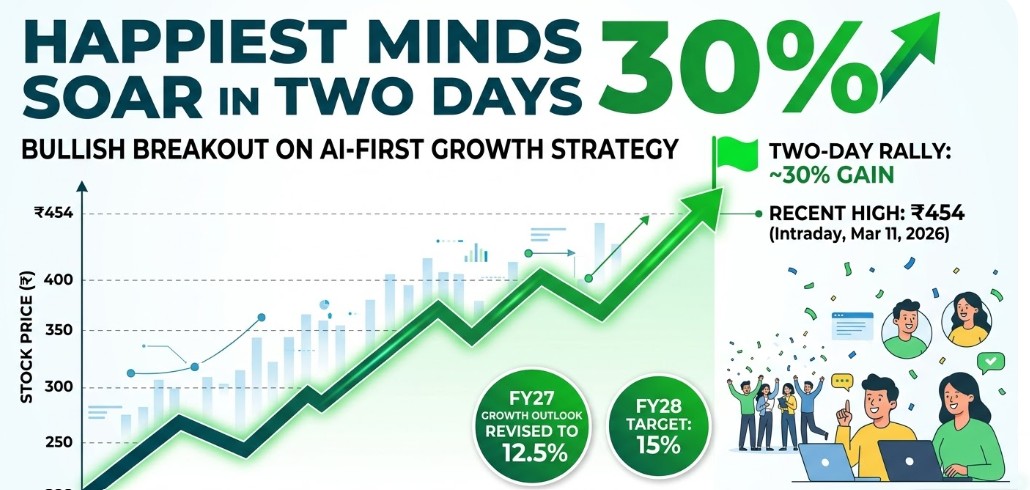
Shares of Happiest Minds Technologies have been on a sharp upward run this week, giving investors plenty of reasons to smile. The Bengaluru-based IT services firm has seen its stock jump almost 30% in just two trading sessions, clearly outperforming the broader market and many other technology stocks.
The sudden rally has grabbed the attention of traders and market watchers. The key reason behind the surge? A stronger growth outlook and the company’s growing focus on Artificial Intelligence (AI).
Company Raises Growth Expectations
The main trigger for the rally was the company’s decision to upgrade its revenue growth forecast for the coming years.
In a recent exchange filing, Happiest Minds said it now expects revenue growth of around 12.5% in FY27, higher than its earlier estimate of 10%. The company is even more optimistic for the year after that, projecting about 15% growth by FY28.
For a mid-sized IT company operating in a global market where tech spending has been uneven, this kind of confidence has impressed investors.
Many IT companies have recently taken a cautious approach to their growth outlook due to global economic uncertainty. Against that backdrop, Happiest Minds’ revised forecast has been seen as a positive signal about its future business pipeline.
The “AI-First” Strategy Driving Optimism
The company’s confidence is closely linked to its “AI-First” strategy, which it introduced in February 2026 as its 11th strategic pillar.
A Bigger Role for AI
Instead of simply adding AI tools to existing services, the company is trying to build more of its technology solutions around AI. This means using AI across development, delivery, and client solutions.
Growing Demand From Clients
Chairman Ashok Soota said the company is already seeing strong interest from clients in sectors like healthcare, manufacturing, and BFSI (banking, financial services, and insurance).
Generative AI Projects Expanding
The company’s Generative AI Business Services unit is also growing quickly. Some projects that began as small pilot programs have now moved into full-scale production for global clients, which is usually a big step in technology adoption.
How the Market Reacted
Investors responded quickly to the news.
On Wednesday, shares of Happiest Minds climbed more than 12%, touching an intraday high of ₹454. This came after the stock had already gained around 17% in the previous session, taking the two-day jump close to 30%.
According to Venkatraman Narayanan, Managing Director of Happiest Minds, the company’s new growth forecast is based on strong client relationships and steady execution, rather than just future expectations.
A Smaller IT Firm Moving Fast
Happiest Minds currently has over 6,500 employees and works with several global clients.
While it is smaller than India’s big IT companies, the firm is trying to position itself as a fast-moving and innovation-focused technology partner. By investing heavily in AI-based services, the company hopes to capture new opportunities as businesses increase their spending on digital technologies.
What Investors Should Keep in Mind
Even though the rally has been strong, some analysts say the stock may be slightly overheated in the short term. Its Relative Strength Index (RSI) is above 70, which often indicates that a stock could be in the overbought zone.
That doesn’t necessarily mean the rally will stop immediately, but it could lead to some profit-taking or a pause in the near term.
For long-term investors, the bigger factor will be whether Happiest Minds can turn its AI strategy into steady revenue growth and compete effectively with larger IT players.
The sharp rise in Happiest Minds shares shows that investors are excited about the company’s AI-focused strategy and improved growth outlook. As more businesses around the world adopt AI and digital solutions, the company is trying to place itself right at the center of this shift.
If its AI initiatives continue to gain traction with global clients, Happiest Minds Technologies could remain a stock that investors keep a close eye on in the coming months.