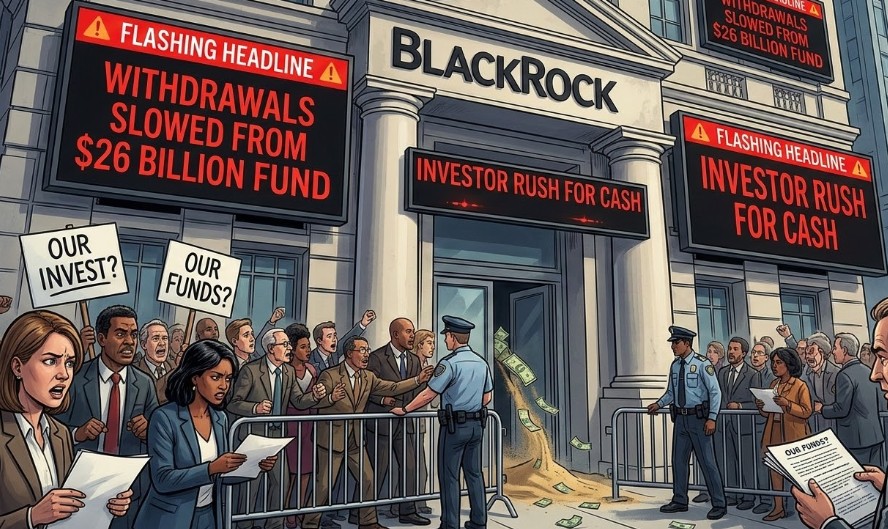
BlackRock, the world’s largest asset manager, has temporarily limited investor withdrawals from one of its major private credit funds after a sudden surge in redemption requests.
The move has caught the attention of global markets. But while the headlines sound dramatic, the situation may be more about risk management than financial trouble.
A Wave of Withdrawal Requests
The fund involved is the HPS Corporate Lending Fund (HLEND), which manages about $26 billion in assets.
During the first quarter of 2026, investors asked to withdraw around $1.2 billion from the fund. That amount equals roughly 9.3% of the total fund size.
However, the fund has a rule that limits withdrawals to 5% per quarter. This cap exists because the fund invests mainly in private loans to companies, which are not as easy to sell quickly as stocks or bonds.
Since the redemption requests crossed that limit, BlackRock allowed only part of the withdrawals and pushed the remaining requests to future quarters.
Why Are Investors Pulling Money Out?
The pressure on BlackRock’s fund reflects a broader trend across the private credit market.
Another major investment firm, Blackstone, recently saw similar demand for withdrawals in its $82 billion private credit fund, Blackstone Private Credit Fund (BCRED).
Instead of strictly limiting redemptions, Blackstone increased its withdrawal cap to 7.9%, allowing more investors to exit.
The recent activity suggests that some investors are becoming cautious about private credit funds, especially in a market filled with uncertainty.
AI Is Also Part of the Story
Interestingly, the rapid growth of Artificial Intelligence could be adding to the concern.
Many private credit funds lend money to mid-sized software and technology companies. With AI evolving quickly, there are worries that some of these businesses could face tougher competition or even disruption.
If those companies struggle, the loans connected to them could become riskier.
BlackRock Shares React
Following the news, shares of BlackRock fell by more than 7% on Friday, closing at about $955.45.
Even so, analysts say limits on withdrawals are fairly common in private credit funds and are designed to protect investors rather than signal a major problem.
A Big Bet on Power and AI
At the same time, BlackRock is still making large investments tied to the AI boom.
A group led by Global Infrastructure Partners recently announced a $33.4 billion deal to buy AES Corporation, a major electricity provider in the United States.
The reason is simple: AI needs huge amounts of electricity.
Data centres that power AI tools require massive energy, and demand for electricity is expected to rise sharply as more AI infrastructure is built.
By investing in power companies, BlackRock is positioning itself to benefit from that growing demand.
The Bigger Picture
Private credit funds have grown rapidly over the past decade as investors looked for higher returns outside traditional markets.
But unlike stocks or bonds, these investments are less liquid, which means money cannot always be withdrawn immediately.
For now, BlackRock’s decision appears to be a precaution built into the fund’s structure, rather than a sign of deeper financial stress.
At the same time, the episode shows how quickly investor sentiment can change, even as firms continue making multi-billion-dollar bets on the future of AI and infrastructure.


