If you recently visited your favourite neighbourhood restaurant and noticed a “limited menu” sign, you’re not alone. Across several cities, some eateries are quietly cutting down dishes. At the same time, stock market watchers have seen shares of gas companies like GAIL and Petronet LNG moving nervously.
Behind these small changes is a bigger issue: India is currently dealing with a sudden shortage of Liquefied Natural Gas (LNG) and LPG cooking gas. The impact is being felt from restaurants and small factories to fertilizer plants and power stations.
So what exactly caused this situation? Let’s look at the key reasons in simple terms.
Trouble on a Key Energy Route
A major reason for the disruption lies thousands of kilometres away. The Strait of Hormuz is one of the most important shipping routes for oil and gas in the world.
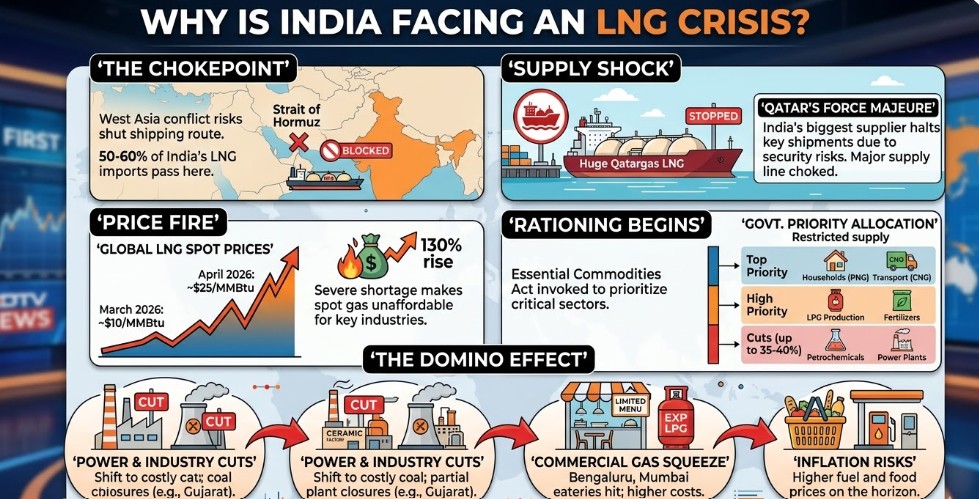
A large portion of India’s LNG imports, roughly 50–60%, passes through this narrow waterway between Oman and Iran.
However, tensions in West Asia have made shipping through the route risky. Since early March 2026, several shipping companies have slowed down or avoided the route due to security concerns. When ships carrying LNG cannot move freely, supplies to importing countries like India get delayed.
Qatar’s Supply Disruption
India’s biggest LNG supplier is QatarEnergy. The country provides almost half of India’s imported natural gas.
Recently, QatarEnergy issued a “Force Majeure” notice for some supplies. This is a legal term companies use when unexpected events, such as conflicts or natural disasters, prevent them from fulfilling their contracts.
Because of this, some shipments have been delayed or temporarily stopped. Importers such as Petronet LNG are now trying to find gas from other markets, which is proving difficult.
Prices Have Jumped Sharply
Whenever supply drops, prices usually rise. That’s exactly what has happened in the global LNG market.
In just a few days this March, Asian LNG spot prices jumped from around $10 to nearly $25 per MMBtu.
For Indian companies, this creates a problem. Gas is not only harder to find, but it has also become much more expensive.
Many industries that depend on gas are already feeling the pressure:
- Fertilizer plants are worried about rising production costs.
- Ceramic and glass factories in Gujarat have started reducing working hours.
- Some power plants are switching back to coal to keep electricity production going.
Why Restaurants Are in Trouble
Household kitchens are unlikely to run out of gas, but restaurants are facing a different situation.
Commercial LPG cylinders, the large ones used by hotels and restaurants, are in short supply. Since the government is focusing on maintaining domestic LPG supply, a large portion of available gas is being directed toward household use.
As a result, many restaurants are struggling to get commercial cylinders. Some have reported paying almost double the usual price, forcing them to reduce menu items or avoid dishes that require long cooking times.
Rupee Falling Problem
Another factor making things worse is the weak Indian currency.
The rupee recently touched 90 Rs against the US dollar. Since LNG is bought in dollars, a weaker rupee means India has to spend more to import the same amount of gas.
This increases the overall cost for energy companies and the government.
Effect on Customers
For now, experts say household LPG supply is being protected, so most homes should not see a shortage. However, businesses that depend heavily on gas may continue to face higher costs.
If global tensions ease and shipping routes become safer, supplies could return to normal. Until then, industries and restaurants may have to adjust to tight gas supplies and rising prices.
In short, a combination of global conflict, supply disruptions, rising prices, and a weaker rupee has created the current LNG squeeze, a reminder that events far away can still affect everyday life in India