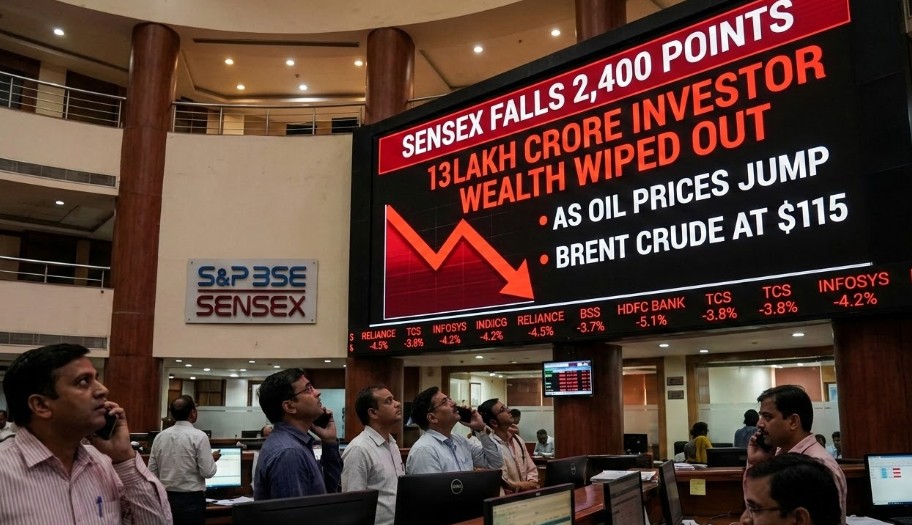
Indian stock markets saw a rough start to the week, leaving investors worried. Monday turned into a painful day on Dalal Street as markets crashed soon after trading began. Within minutes, investors lost nearly 13 lakh crore in market wealth due to heavy selling.
The benchmark index BSE Sensex plunged over 2,400 points, touching an intraday low of 76,424. At the same time, the broader market index Nifty 50 dropped more than 700 points, struggling to stay above the 23,750 level.
Selling pressure was seen across many sectors, including banking, IT, and auto stocks, as investors rushed to reduce risk amid global uncertainty.
Why Are Markets Falling?
Several global and domestic factors came together to trigger today’s sharp fall in the markets. Here are the main reasons:
Rising Tensions in the Middle East
Tensions involving Iran, Israel, and the United States increased over the weekend. The situation has raised fears of a wider conflict in the region.
Whenever geopolitical tensions rise in the Middle East, global markets usually react quickly because the region plays a major role in global oil supply.
Oil Prices Shoot Up
Global crude prices have jumped sharply, with Brent Crude moving above $115 per barrel.
For India, this is a concern because the country imports more than 85% of its oil needs. Higher oil prices can push up inflation, increase fuel costs, and put pressure on the economy.
Rupee Falls to a Record Low
The Indian Rupee weakened further and slipped past ₹92 against the US dollar.
A weak rupee makes imports costlier and can also lead to foreign investors pulling money out of Indian markets, which adds to the selling pressure.
Global Markets Are Also Under Pressure
It’s not just India that is seeing a fall. Stock markets across Asia also dropped sharply.
Japan’s Nikkei 225 and South Korea’s Kospi declined between 3% and 6%, following weak signals from Wall Street last week.
This global sell-off has added to the negative sentiment in Indian markets.
What Experts Are Saying
Market experts say investors should avoid panic selling despite the sharp fall.
According to analysts, such corrections are common when global tensions rise and oil prices surge. They believe the long-term outlook for the Indian economy remains stable.
Some experts even say that market dips can give long-term investors a chance to buy strong stocks at better prices, though volatility may continue in the short term if global tensions remain high.


