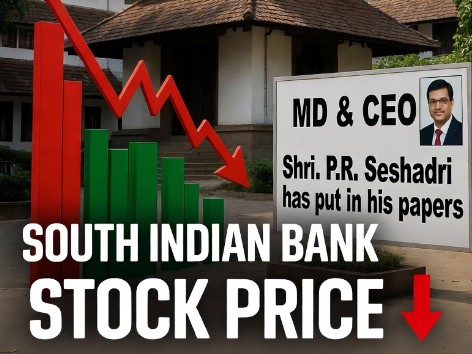
South Indian Bank (SIB) grabbed market attention on January 30, 2026, after its stock crashed nearly 19% in a single session, stunning investors. The sharp fall came even as the bank posted its highest-ever quarterly profit, leaving many wondering what went wrong.
While SIB’s financial health looks strong on paper, the stock market reacted nervously to a major leadership development that raised fresh uncertainty. Here’s a closer look at why the shares took such a beating.
CEO Surprise: PR Seshadri to Exit After Current Term
The biggest trigger for the sell-off was the announcement that Managing Director and CEO PR Seshadri will not seek reappointment once his term ends on September 30, 2026.
Why it matters: Seshadri is widely respected in the market and is seen as the key force behind South Indian Bank’s turnaround. He played a crucial role in improving profitability and addressing the bank’s bad-loan problem.
The reason: In its regulatory filing, the bank said Seshadri plans to pursue “personal interests” after completing his tenure.
Market reaction: Investors usually don’t like uncertainty at the top. The sudden announcement sparked concerns about a possible leadership gap, as the process of finding and getting RBI approval for a new CEO could take time. This led to panic selling during the session.
The reaction was swift and brutal. South Indian Bank shares slid to an intraday low of ₹36.01, marking a drop of nearly 19% from the previous close. Reports suggest this is the stock’s steepest single-day fall in more than seven years, last seen in July 2018.
Strong Numbers Fail to Calm Nerves
Ironically, the sell-off came just after the bank delivered an impressive performance for the third quarter of FY26:
Record Net Profit: South Indian Bank reported its highest-ever quarterly net profit of ₹374.32 crore, up 9% year-on-year.
Income Growth: Net Interest Income (NII), which reflects earnings from lending, jumped 19% to ₹486 crore.
Better Asset Quality: The bank’s balance sheet continued to improve, with gross NPAs falling sharply to 2.67%, compared with 4.30% a year ago