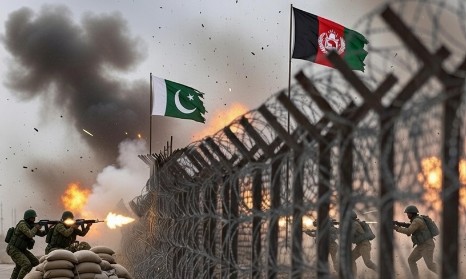
What was once a simmering border dispute has now turned into a full-blown military confrontation. Tensions between Islamabad and Kabul have reached a flashpoint, with Pakistan’s Defence Minister describing the situation as an “open war.”
If you’ve come across headlines about airstrikes in Kabul or Pakistan’s “Operation Ghazab lil-Haq” and wondered how things spiraled so quickly, here’s a simple breakdown of what’s happening and why it matters.
What Triggered The Escalation?
The latest round of hostilities began on February 26, 2024, when Afghan forces launched a large-scale offensive targeting Pakistani military posts along the border.
According to Kabul, this was not an unprovoked attack. Afghan officials described it as retaliation after Pakistan carried out airstrikes earlier that week in the provinces of Paktika and Khost.
Islamabad responded almost immediately.
Within 24 hours, the Pakistan Air Force (PAF) launched Operation Ghazab lil-Haq, translated as “Wrath for Truth.” The operation reportedly struck targets deep inside Afghan territory, including in the capital Kabul and Kandahar, the Taliban’s traditional southern stronghold.
Pakistan’s Information Minister, Attaullah Tarar, claimed that more than 400 Afghan Taliban operatives were killed in the strikes. He also stated that dozens of military posts and armored vehicles were destroyed.
Kabul, however, tells a very different story.
Afghan authorities say more than 50 civilians, including women and children, were killed in the airstrikes. They also claim their forces killed dozens of Pakistani soldiers and even shot down a Pakistani fighter jet. Islamabad has firmly denied the jet downing claim.
As is often the case in active conflicts, both sides are presenting sharply contrasting versions of events.
Why Are Pakistan And Afghanistan Fighting?
At the heart of this confrontation lies a familiar name: the Tehreek-e-Taliban Pakistan (TTP).
Islamabad accuses the Afghan Taliban of allowing TTP militants to operate from Afghan soil. According to Pakistan, these fighters cross the border to carry out deadly attacks inside Pakistan before retreating into Afghanistan.
Kabul has repeatedly denied offering any haven to the TTP. But trust between the two governments has eroded sharply over the past two years, especially since the Taliban returned to power in Afghanistan in 2021.
Another major source of friction is the long-standing Durand Line dispute.
The two countries share a 2,600-kilometre border known as the Durand Line. Pakistan considers it a recognized international boundary. Afghanistan, however, has never officially accepted it as such.
This disagreement fuels regular clashes over border fencing, patrol routes, and the construction of military posts. Even minor incidents along this stretch can quickly escalate into larger confrontations.
What Happens Next?
The situation has raised alarm bells beyond South Asia. Regional powers, including China, Iran, and Russia, have called for immediate de-escalation. All three have significant strategic and economic interests in the region and are wary of the conflict spilling over into a wider instability zone.
Diplomatic channels are reportedly active, with mediation efforts being discussed. However, with military operations ongoing, the path to calm remains uncertain.
Meanwhile, the humanitarian fallout is growing.
Border crossings have largely shut down. Trade between the two countries has come to a standstill, hurting local businesses and daily wage workers on both sides. Thousands of civilians, including refugees who regularly move across the border, are now caught in the middle.
Pakistan’s Prime Minister Shehbaz Sharif has cancelled key international visits to manage the crisis domestically, a sign of how seriously Islamabad views the current escalation.
A Conflict Years In The Making
While the current flare-up may seem sudden, the roots of this conflict go back decades. Militancy, cross-border infiltration, and unresolved territorial disputes have repeatedly strained relations between the two neighbors.
The difference this time? The scale.
With air power being used and casualties mounting on both sides, this is no longer just another border skirmish. It marks one of the most serious military escalations between Pakistan and Afghanistan in recent years.
Whether this turns into a prolonged conflict or is contained through diplomacy will depend on decisions made in the coming days.
For now, the region watches anxiously as two uneasy neighbors edge dangerously close to a wider war.