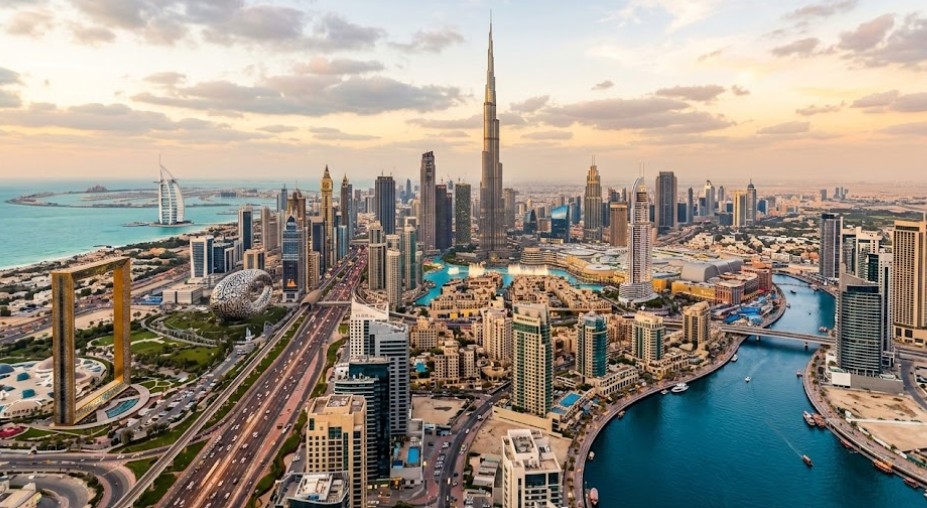
When you think of Dubai, chances are the first images that pop up are the towering Burj Khalifa, luxury shopping malls, and supercars cruising down Sheikh Zayed Road. But beyond the glamour lies something far less talked about, one of the most advanced and well-funded military forces in the Middle East.
Dubai is a key emirate of the United Arab Emirates (UAE), and its defense falls under the federal command of the UAE Armed Forces. Often nicknamed “Little Sparta” by military experts, a label reportedly popularised by former US officials, the UAE has built a reputation for punching well above its weight in regional security.
So, how much is being spent? And what exactly is in their high-tech arsenal? Let’s break it down.
How Much is the UAE Spending?
The UAE doesn’t just purchase weapons, it invests in what it sees as a long-term, future-ready security shield.
As of 2026, the country’s defense budget is projected to reach approximately $25.1 billion, marking a steady rise from around $18.7 billion in 2021. If current projections hold, spending could climb to a staggering $30.2 billion by 2030.
That’s a significant commitment for a country with a relatively small population.
While the UAE has scaled back its direct involvement in overseas conflicts such as the Yemen civil war, the strategy has shifted toward modernization, advanced technology, and domestic manufacturing. In simple terms, they’re no longer just importing weapons; they’re building them.
The country is also positioning itself as a regional defense manufacturing hub, reducing dependence on foreign suppliers and boosting homegrown innovation.
The “Hardware” Store: What’s in the Arsenal?
The UAE follows what can best be described as a “best of the best” shopping strategy. It sources cutting-edge technology from the US, France, and other global suppliers — while steadily ramping up domestic production.
Here’s a look at the key pillars of its military power.
The Wings: Air Power
If there’s one area where the UAE truly shines, it’s in the skies.
In a record-breaking deal with France, the UAE ordered 80 Rafale F4 fighter jets from France. The Dassault Rafale F4 variant is among the most advanced multi-role combat aircraft in the world, capable of air superiority, ground attack, and intelligence missions.
The country already operates roughly 76 F-16 Block 60 jets, a version specially customized for the UAE. The F-16 Fighting Falcon Block 60 was, for a period, considered even more advanced than many versions flown by the US Air Force.
Unmanned systems are another major focus area. The UAE deploys drones like the Bayraktar TB2 from Turkey and the Wing Loong II from China both battle-tested platforms widely used in modern warfare.
In today’s world, air superiority isn’t optional, it’s essential. And the UAE clearly understands that.
Air Defense: Building a Protective Umbrella
Being located in a geopolitically sensitive region means missile defense is a top priority.
The UAE made headlines as the first international buyer of the US-made THAAD (Terminal High Altitude Area Defense) system. Designed to intercept and destroy ballistic missiles at high altitudes, THAAD forms a critical layer of the country’s defensive shield.
Adding another layer is the Saab GlobalEye, an airborne early warning and control system from Sweden. Think of it as a “giant radar in the sky,” capable of detecting aerial and maritime threats hundreds of miles away.
Together, these systems create a multi-layered air defense network, crucial in a region where missile and drone threats are very real.
Tanks and Armor: Power on the Ground
On land, the UAE fields the French-made Leclerc tank as its primary main battle tank, with over 350 units in service. Known for its firepower and mobility, the Leclerc has also seen operational deployment in the region.
But the real story is domestic manufacturing.
Through EDGE Group, a major state-backed defense conglomerate, the UAE now produces its own armored vehicles, including the Nimr and Rabdan 8×8 platforms. These vehicles are not only used domestically but are also exported to other countries, marking the UAE’s growing footprint in the global arms market.
This shift toward local production reflects a broader strategy: self-reliance, technological advancement, and economic diversification beyond oil.
The Bigger Picture
The UAE’s military buildup isn’t just about firepower; it’s about positioning.
By combining high-end Western technology with rising domestic capabilities, the country is transforming itself into both a regional security heavyweight and an emerging defense manufacturing hub.
For a nation better known for luxury tourism and architectural marvels, its military muscle tells a very different story, one built on strategy, deep pockets, and a clear eye on the future.